Electric Charges and Fields
- There are two types of electrical charges, Positive and Negative.
- SI unit of electrical charge is coulomb (C)
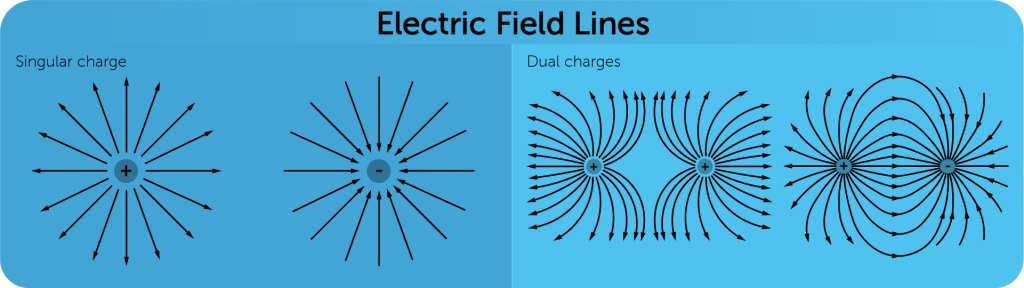
- Electric field lines are the imaginary paths along which a positive charge would move in an electric field.
- Two electric filed lines never intersect each other otherwise the electric field line at a point will simultaneously have two directions which is impossible.
- Electric field lines can never intersect.
- Electric fields have an infinite range.
- The direction of an electric field is the direction in which the electrostatic force will act on a charged particle.
Conductors and Insulators
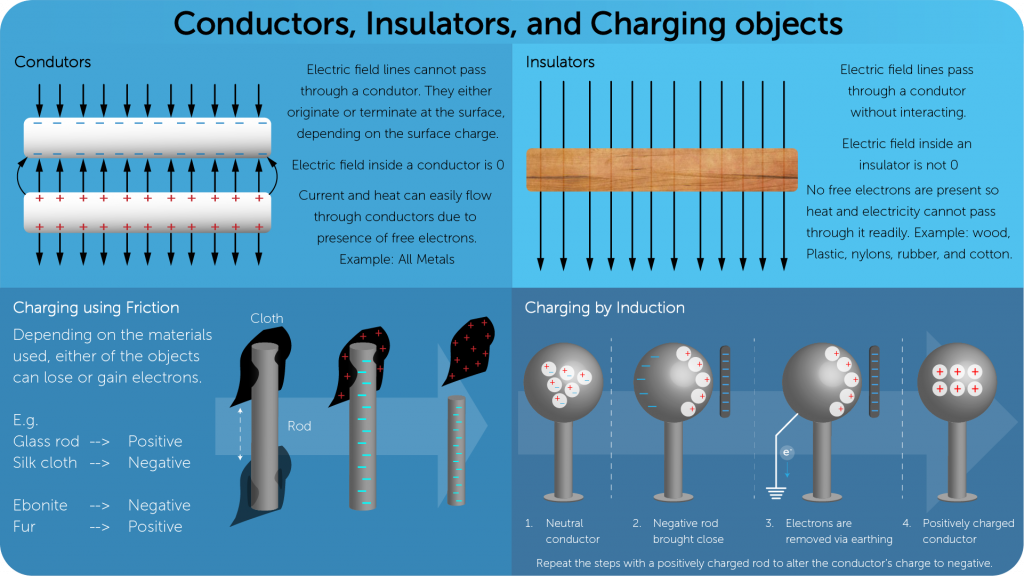
- Electric field lines cannot pass through a conductor – they terminate at the conductor, as the field inside a conductor is zero.
- All the excess charge resides on the outer surface of the conductor.
Current
- Current is the rate of flow electric charge in a conductor, given by the following relationship:

- Current (I) is measured in SI unit of ampere (A), Charge (Q) in Coulombs (C), and time (t) in seconds (s).
- Current in a circuit is measured with an Ammeter.
- Ammeter can be analogue or digital.
- An analogue ammeter can measure the flow of current in one direction only.
- A digital ammeter can measure both positive and negative currents.
- The internal resistance of an ideal ammeter is 0, so it does not draw any power in a circuit.
- An ammeter is to be connected in series with any electrical appliance.
- Conventional current is drawn going from the positive terminal to the negative terminal, but as current is primarily the flow of negatively charged electrons, the electron flow is in the opposite direction to the conventional current.
Electromotive Force and Potential Difference
- Electromotive Force (
 ) is the energy supplied by an electrical source in driving a unit positive charge once around a complete circuit.
- SI unit of emf is Volt (V) which is the ratio of electrical energy supplied by a source (J) and charge (C)
- Potential Difference (V) is the energy consumed by an electrical appliance when a unit positive charge goes across it.
- SI unit of Potential difference is also Volt (V), the same as emf.
- The sum of all potential differences across appliances in a circuit is equal to the terminal potential difference across all electrical power supplies in the circuit.
- The sum of all potential differences across a circuit is 0V.
- The terminal potential difference (V) across an electrical power supply is the difference between the emf and the product of the current (I) and internal resistance (r) of the power supply.
Voltmeters
- A voltmeter measures potential difference across two points.
- Ideally no current should pass through a voltmeter
- As such, an ideal voltmeter has infinite resistance.
- A voltmeter should always be connected in parallel with any electrical appliance.
- emf can be measured by using an ideal voltmeter across a power supply.
- A circuit with
 resistance will have 0A current, allowing us to exactly measure the emf ().
- There are two type of voltmeter: analogue and digital.
- An analogue voltmeter has a finite range and can only measure positive value of potential difference
- A digital voltmeter has a large range. It can measure both positive and negative potential differences.
- Accuracy of digital voltmeter is higher than analogue.
Resistance
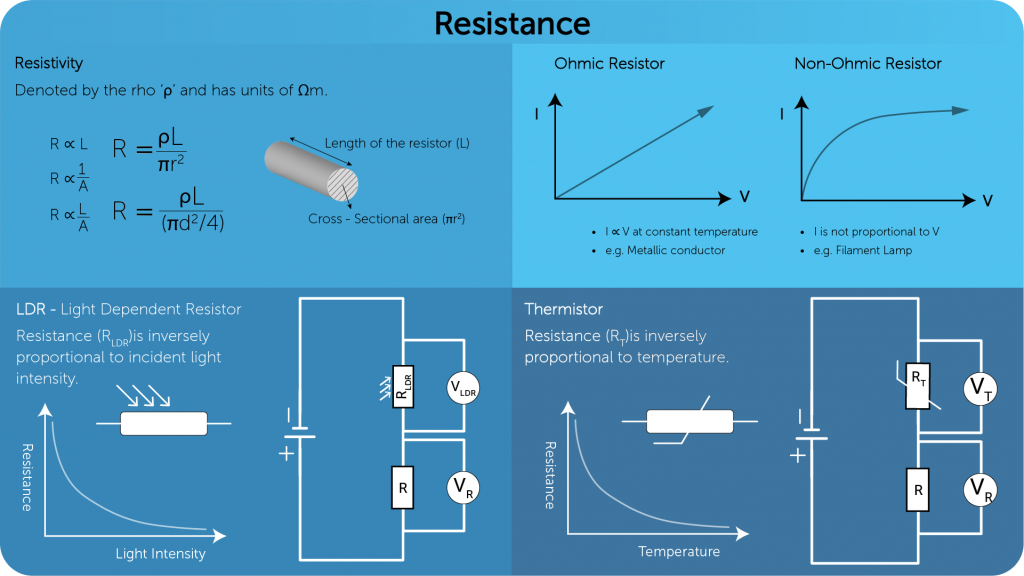
- Ohm’s Law: At constant temperature, electric current flowing through conductor is directly proportional to the potential difference across it.
 or
or 

where R is the proportionality constant in the relationship and is the Resistance in Ohms.
- Resistance is the ratio of potential difference across an appliance to the electric current flowing through it.
- SI unit is Ohm


Thermistor
- Resistance of the thermistor decreases with an increase in temperature
- When the resistance of the thermistor decreases, the current in the circuit increases
- Potential difference in the whole circuit remains the same, but the individual energy consumptions change
Light Dependent Resistor (LDR)
- Resistance of the LDR decreases with an increase in incident light intensity.
- When the resistance of the LDR decreases, the current in the circuit increases.
- Potential difference in the whole circuit remains the same, but the individual energy consumptions change
Electrical Energy
- From the definition of potential difference and emf:
}&space;=\frac{\textup{electrical&space;energy&space;(J)}}&space;{\textup{charge&space;(C)}})


&space;\times&space;It)


&space;Vt)


Electrical Power and kWh
- Power (P) is Energy (E) per unit time (t) and has units of Watt (W).


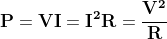
- 1 Commercial unit of electrical energy is 1 kiloWatt-hour .