Waves:
- It is the periodic oscillations of particles in a medium, which propagate, transferring energy and momentum with them.
- There are two types of progressive waves: Transverse and longitudinal.
- Also, can be classified as Mechanical (need a medium) and Electromagnetic (does not need a medium) wave.
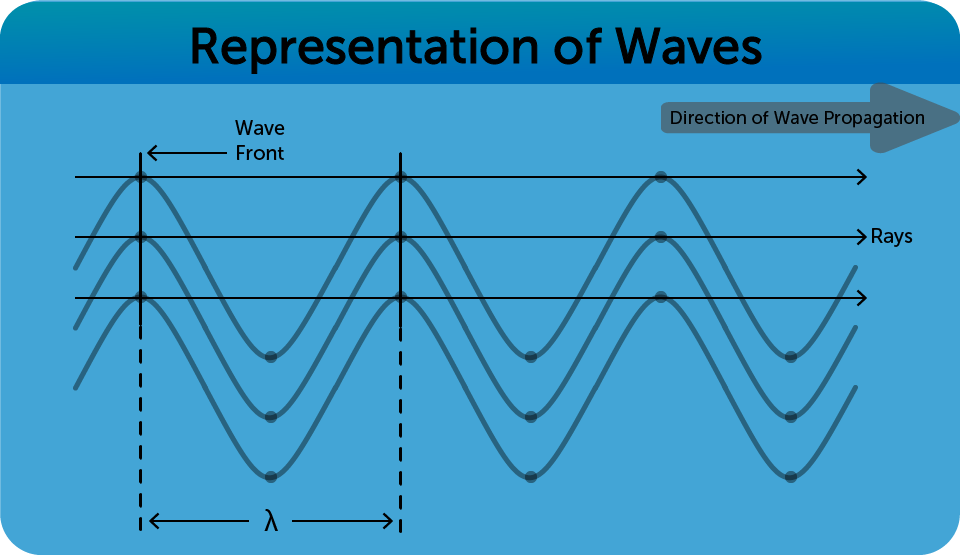
- Graphically a wave can be represented by a sinusoidal wave of displacement and distance.
Wavefronts and Rays
- It is the locus of all the points in waves which are in the same phase or in the same state of vibrations.
- Wave front is perpendicular to the direction of the wave, indicated by directed arrows called rays.
Amplitude
- It is the maximum displacement of a particle from its mean position in a wave.
Time period
- It is the time taken by an oscillating particle to complete 1 oscillation in a wave.
- It is the time taken by a wave to complete one cycle.
- SI unit is second.
Frequency
- It is the number of oscillations completed by a particle in one second
- Number of cycles completed by a wave per second.


- SI unit is hertz (Hz) or rad/s, for angular frequency,
 . T is the Time Period.
Wavelength (λ)
- It is the distance between two consecutive wave fronts in a wave
- It is the distance between two consecutive crests or troughs in a wave (Transverse)
- It is the distance between two consecutive compressions or rarefactions in longitudinal wave.
Example
- Show that


- In Time Period the wave covers a distance
 . Therefore
  as
as
Longitudinal vs Transverse Waves
| Longitudinal wave
|
Transverse wave
|
| Particles of the medium vibrate along the direction of travel of the wave (direction of propagation)
|
Particles of the medium vibrate at right angles to the direction of propagation of wave.
|
| All particles vibrate with same Time Period and Amplitude.
|
All particles vibrate with same Time Period and Amplitude.
|
| Medium is divided into alternate compressions and rarefactions. Compressions are the points where pressure and density of the medium will be greatest. Rarefactions are the points where pressure and density are least. |
Medium is divided into alternate crests and troughs; crests are the points where the particles displacement is positive and maximum. Troughs are the points where particle displacement is maximum and negative. |
| Density and pressure of the medium vary from maximum to minimum or vice versa.
|
Pressure and density of the medium remain constant throughout the medium.
|
| It can travel through solid, liquid, and gases.
|
It can only travel through solids and can be generated on the surface of a liquid. Waves on a rope, water waves, electromagnetic waves.
|
| Examples: Sound wave, waves in a spring |
Examples: Waves on a rope, water waves, electromagnetic waves |
Diffraction
- Spreading of waves around the edges of an obstacle with a gap is called diffraction.
- Degree of diffraction depends upon the relative size of the wavelength and the gap.
- Greater wavelength, greater diffraction.
- remains constant after diffraction
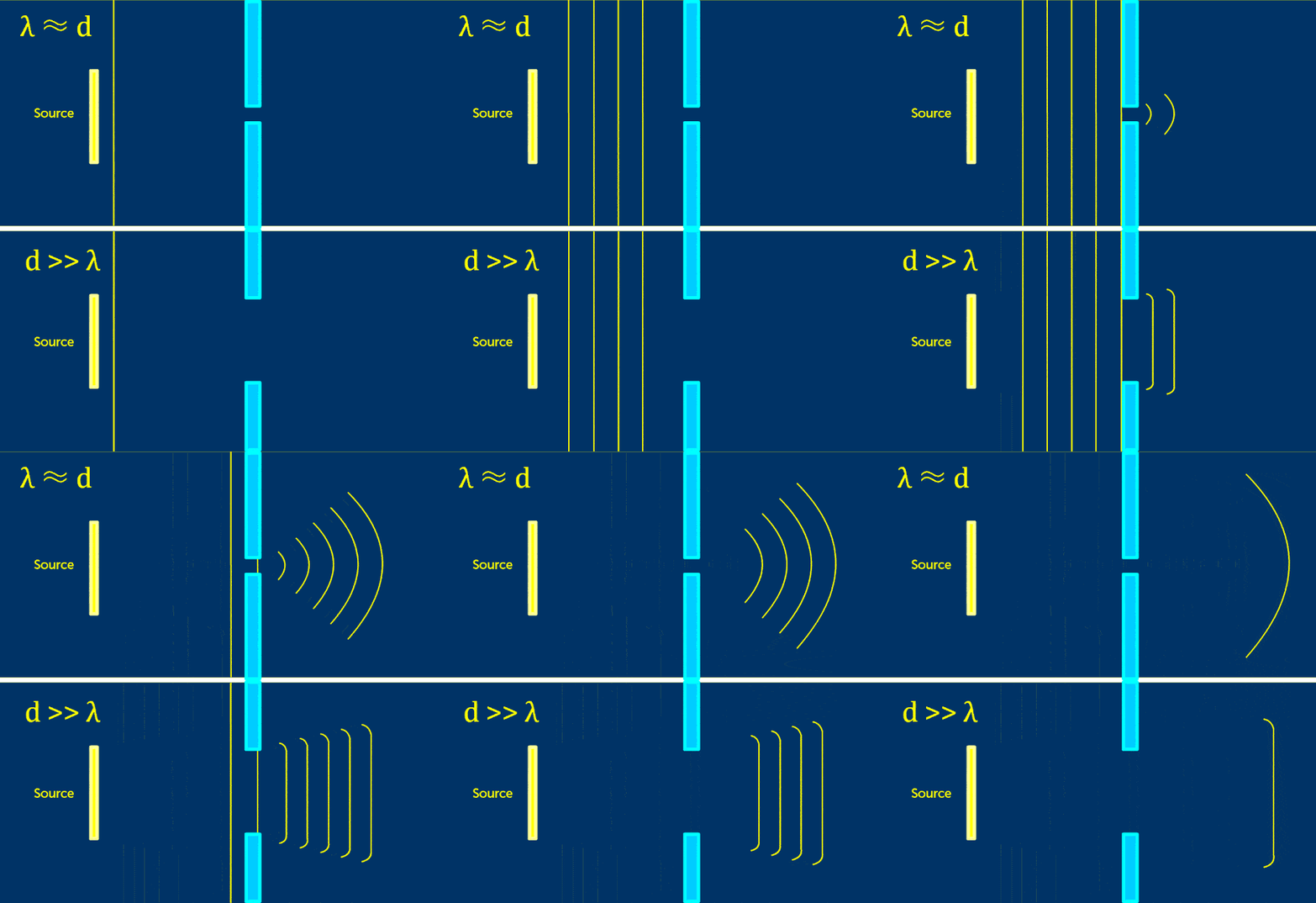
- d = gap size
- Narrow gap:

- Circular pattern
- Wide gap:

- Rectangular pattern
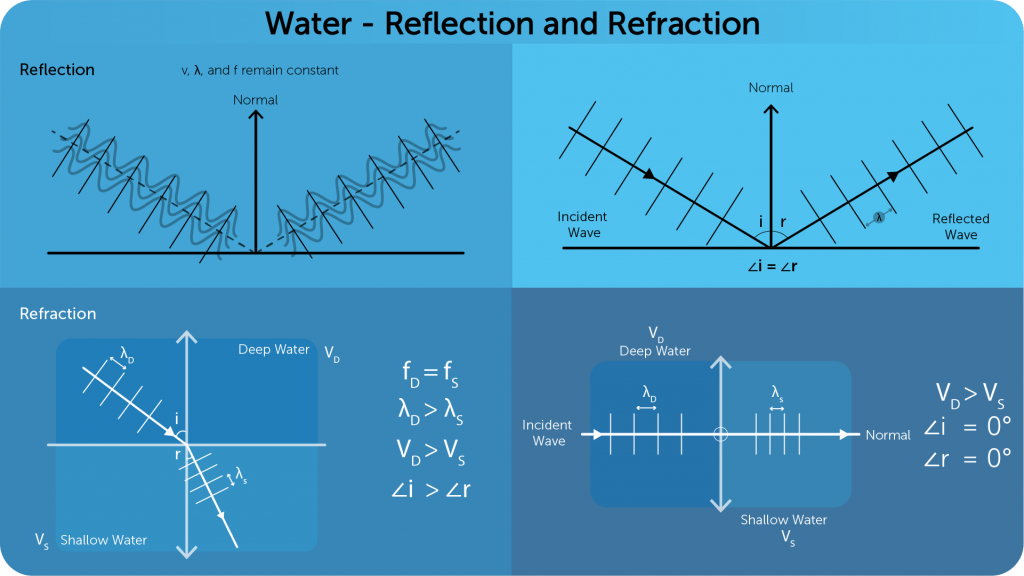
Water Waves