Reflection of light
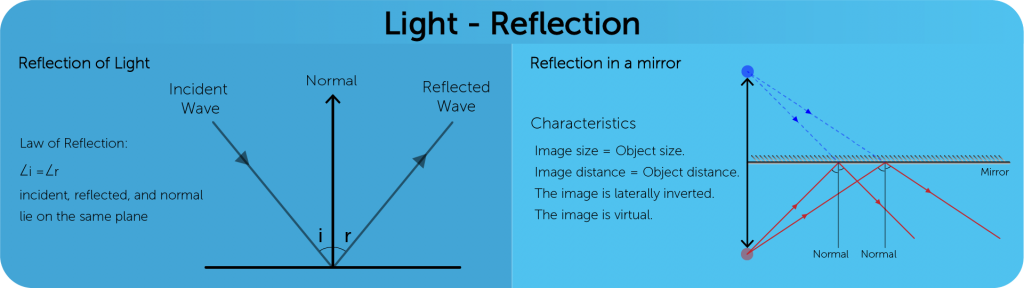
- Real image: it can be formed on a screen and is always inverted
- Virtual image: it cannot be formed on a screen. It is upright and it can be laterally inverted.
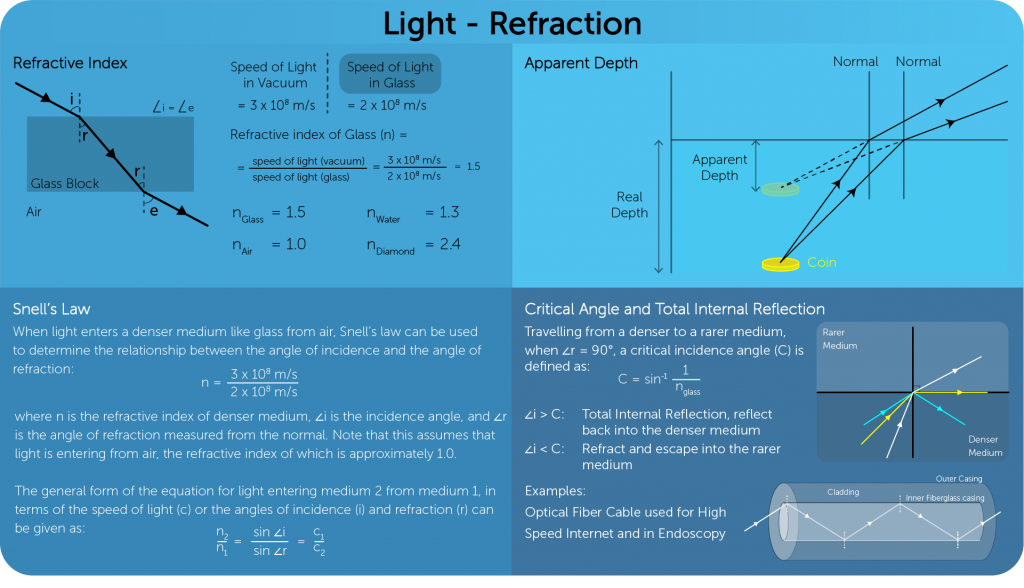
Refraction of light
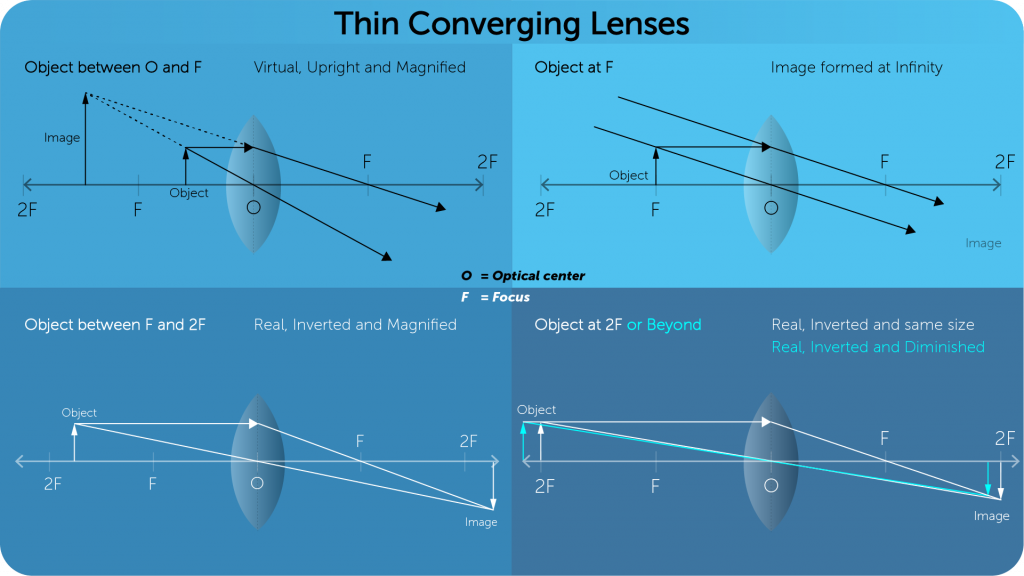
Thin converging lens
Properties of a Thin Converging Lens
- Two convex lenses are merged to form a converging lens.
- Radius of curvature = 2 x focal length
- Focal Length is the distance between the optical center of a lens to its principal focus.
Rules for ray diagrams
- The ray of light which is parallel to the principal axis meets the optical plane. After the refraction, it should pass through the principle focus.
- A ray of light passing through the optical centre will not bend at all. Its path would be straight.
- A ray of light which passes through the principal focus before it meets the optical plane, it refracts through the lens and becomes parallel to the principal axis.
 Uses of converging lens
- It can be used in magnifying glasses. It can also be used in cameras and microscopes.
- Real vs. Virtual Images
| Real Image |
Virtual Image |
| Can be formed on a screen |
Cannot be formed on a screen |
| Generally inverted |
Can be inverted or upright |
| Can be magnified or diminished |
Always magnified |
| Forms on the opposite side of the object |
Forms on the same side as the object |
Dispersion of Light
Monochromatic light
- It is a ray of light of a single frequency or a single wavelength.
Dispersion of Light
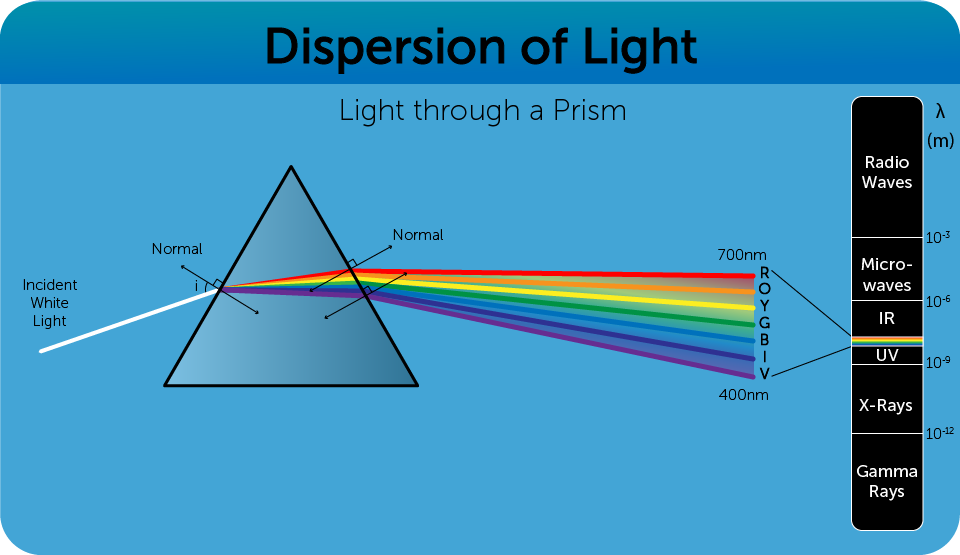
Splitting of a white ray of light into its constituent colors is called dispersion of light. It occurs in glass prism or in water bubbles. Speed of all the colors are same in air or in vacuum but when it refracts in a medium like water/glass, all colours travel with different speeds so their refractive index is different in the prism, and it refracts at different angles.