Force
- It is the product of mass and acceleration of an object
- It is a vector quantity
- F = m x a
- SI unit is N or kg m/s2
- An applied force can change the shape, size, speed, and the direction of movement of an object, but cannot change its mass.
Net Force
- When acting in the same direction, the forces are simply added together to obtain the net force.
- Calculate the acceleration of the object –

Translational Equilibrium
- Translational equilibrium occurs when along a straight path, net force is zero.

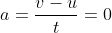
- If
 then
then  and the body is at rest.
- If
 , then
  and the body moves at a uniform velocity.
- So, to be in translational equilibrium, either the object should be at rest or moving with uniform velocity.
Friction, Air Resistance, and Terminal Velocity
Friction
- Frictional forces are resistive forces acting on a body, working to oppose its relative motion.
- Its directed to impede motion, i.e. its direction is always opposite to the motion of an object.
- The energy lost is converted to heat and sound, heating the objects.
- It arises due to interlocking between two surfaces in contact.
- Presence of a liquid or lubricants reduces the frictional force between two surfaces in contact.
Air Resistance
- Air resistance arises due to fluid friction – i.e. when an object moves through a fluid, the frictional force it experiences is known as air resistance
- It increases with speed
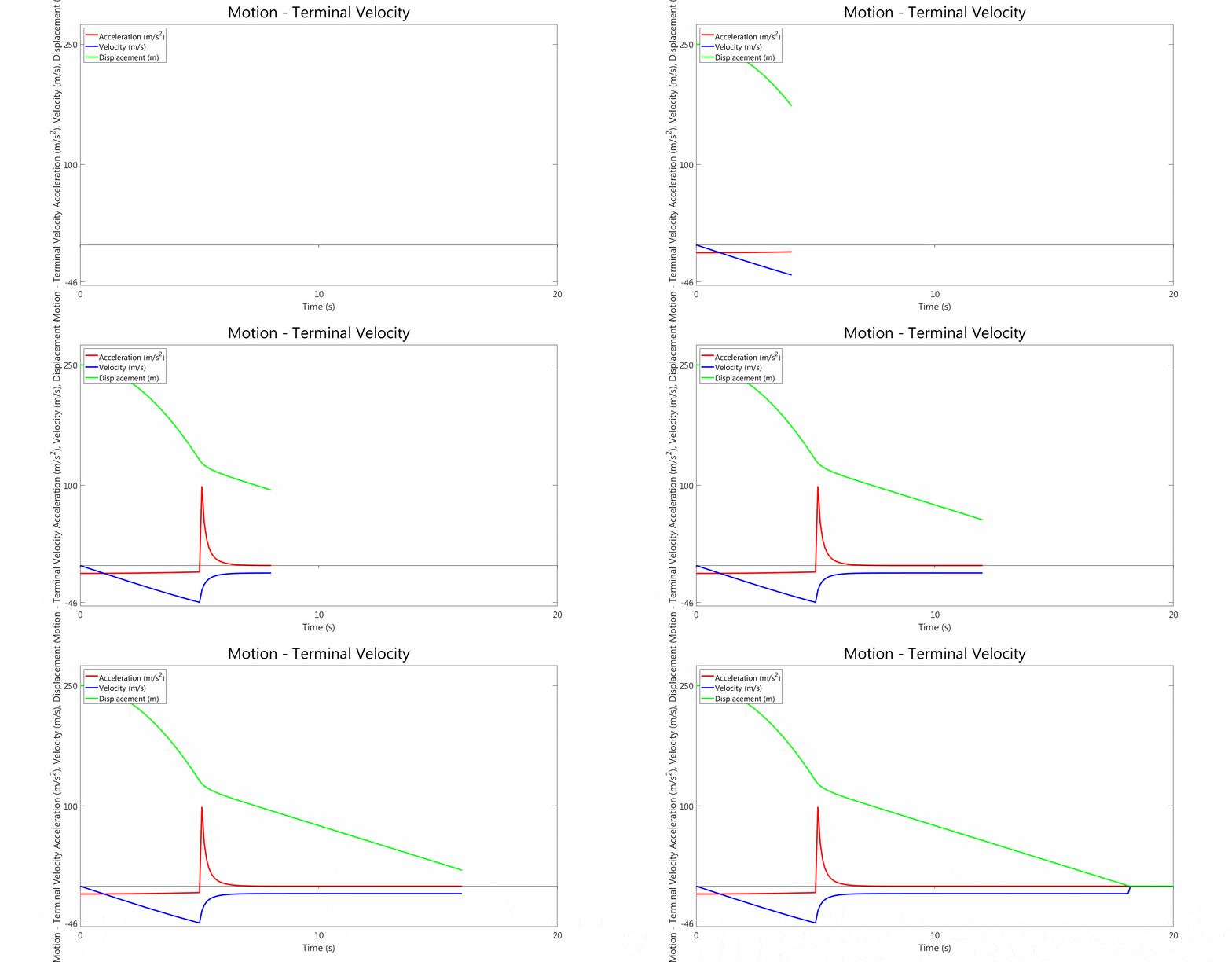
- When a falling object speeds up enough to cause the air resistance to equal the force of gravity, the constant speed is known as terminal velocity.
- At the terminal velocity,
- Body is in equilibrium,
- Net force on the body is

- Acceleration is

- Speed is constant
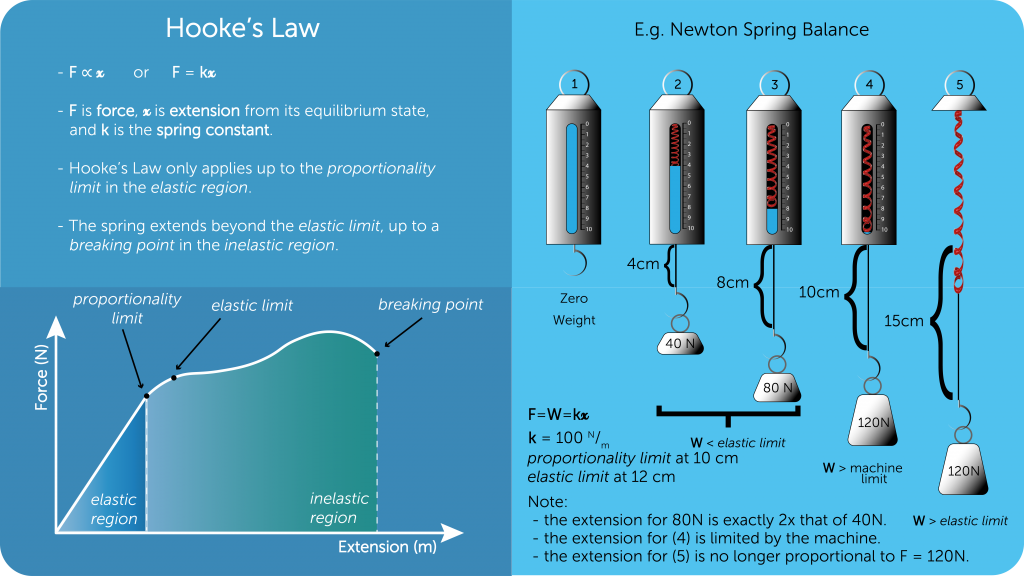
Hooke’s Law
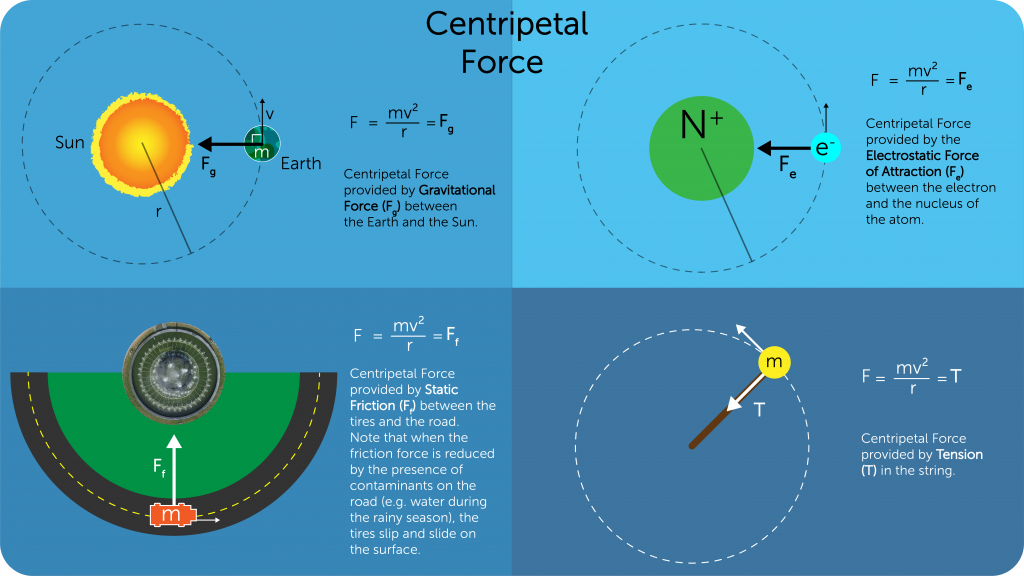
Centripetal Acceleration
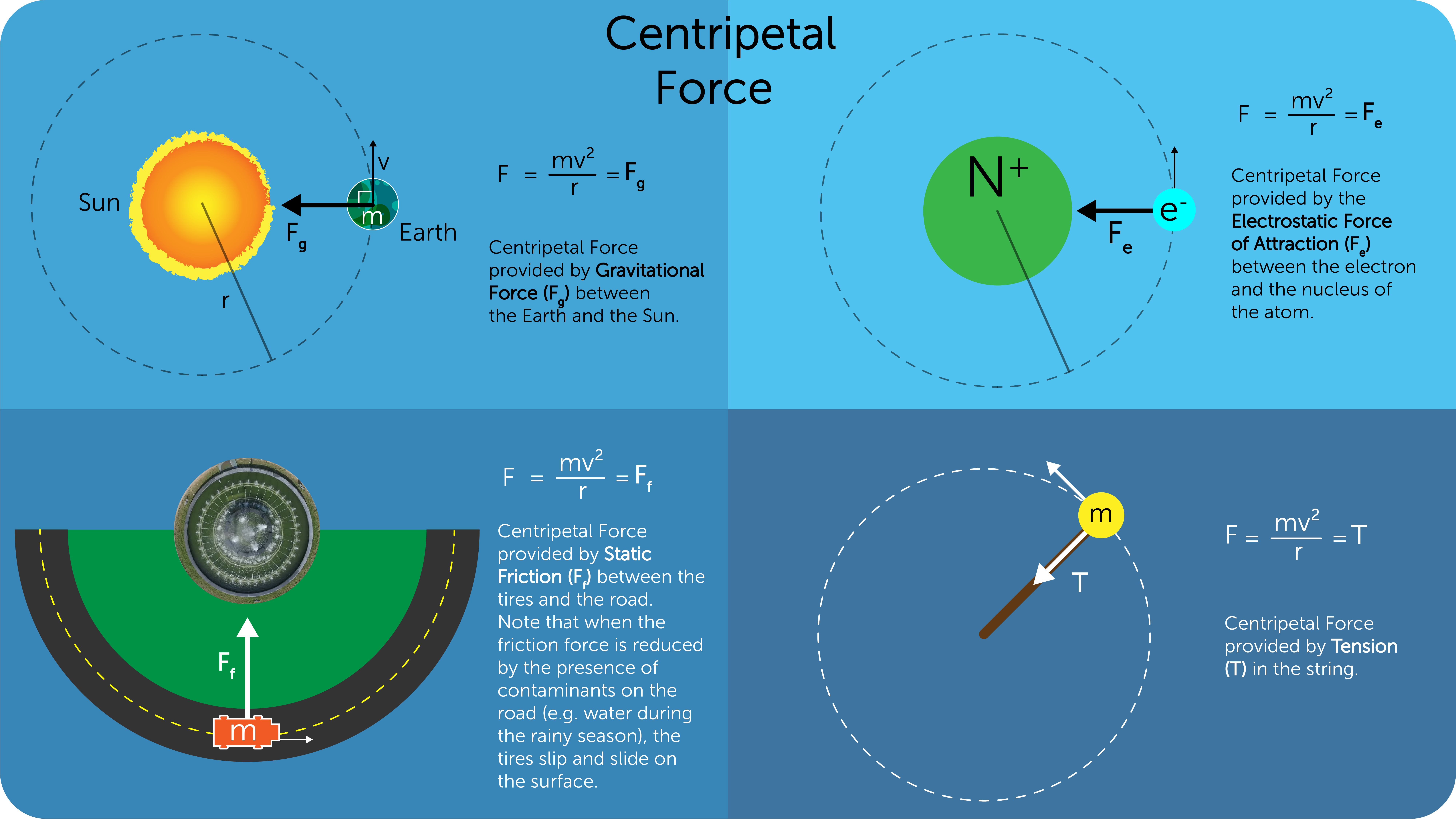
- A body moving in a circular path with a constant speed is accelerated because of its changing direction, i.e. velocity is not constant.
- This acceleration is perpendicular to its direction of motion at all times.
- Thus, the net force is perpendicular to the motion at all times in circular motion.
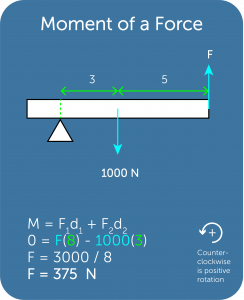
Moment of a Force
- It is the product of force and the perpendicular distance from the line of action of the force to the pivot about which the object is rotating
- It is a vector quantity

- SI unit is

- Not
}) !
!
Rotational Equilibrium
- To be in complete equilibrium, both the net force and net moment on an object must be zero.
- This means the object must be in translational and rotational equilibrium.
- For rotational equilibrium, i.e. zero or constant rotational speed
- Total clockwise Moment Total anticlockwise Moment
- The following are multiple examples depicting this concept
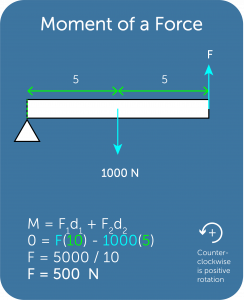
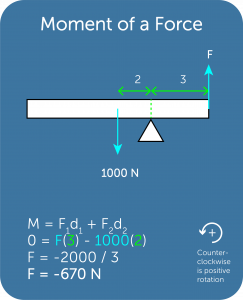
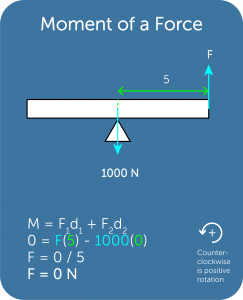
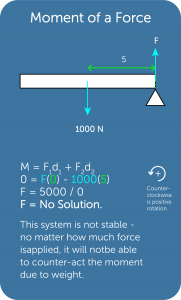

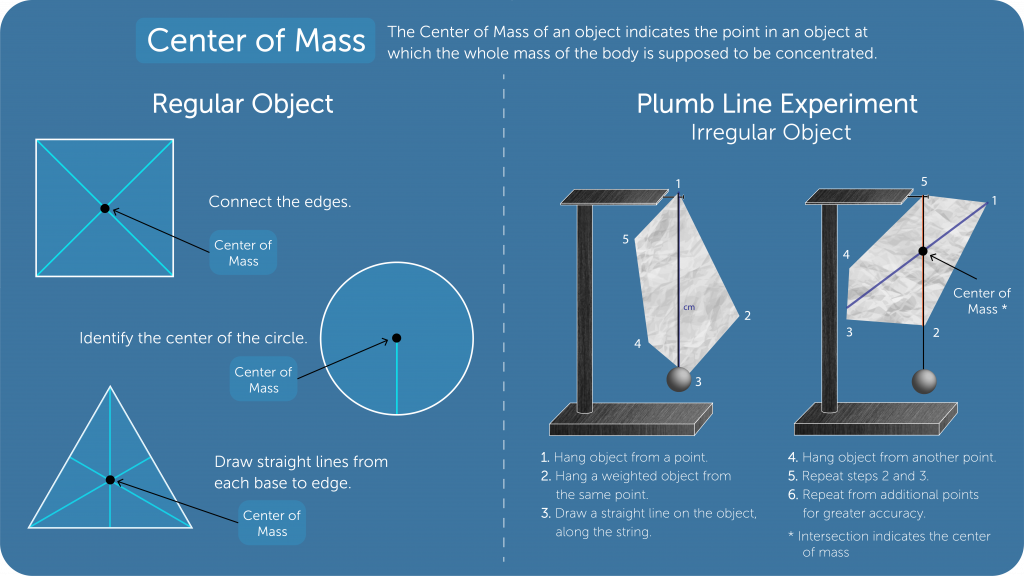
Center of Mass
- It is a point in an object at which the whole mass of the body is supposed to be concentrated.

Scalars and Vectors
Scalars
- A scalar quantity only consists of a magnitude
- It is independent of direction.
- Scalars can be algebraically added
- 2 kg of apples + 3 kg of apples = 5 kg of apples
Vectors
- A vector quantity consists of both a magnitude and a direction.
- Vectors follow the rules of vector addition,
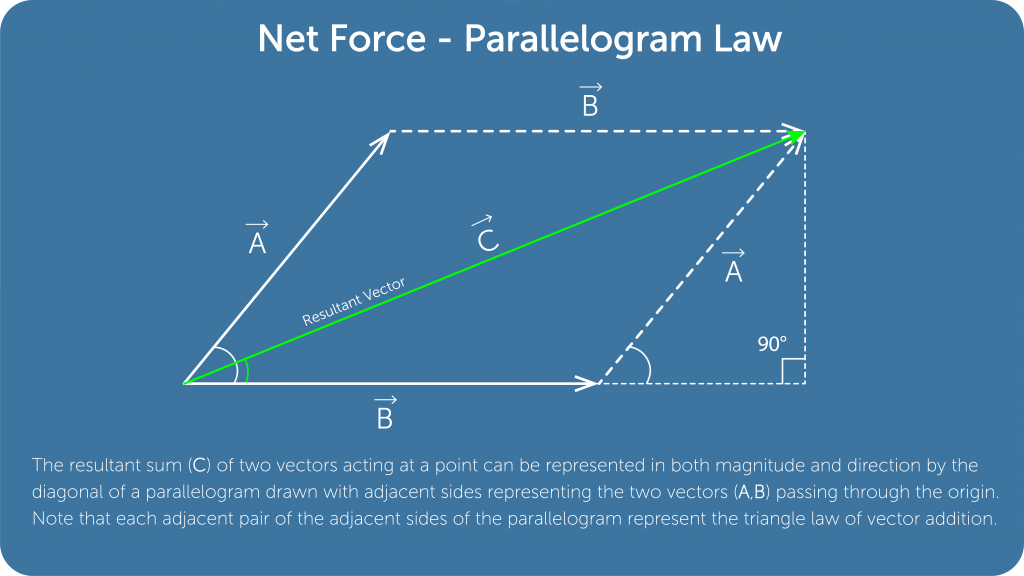
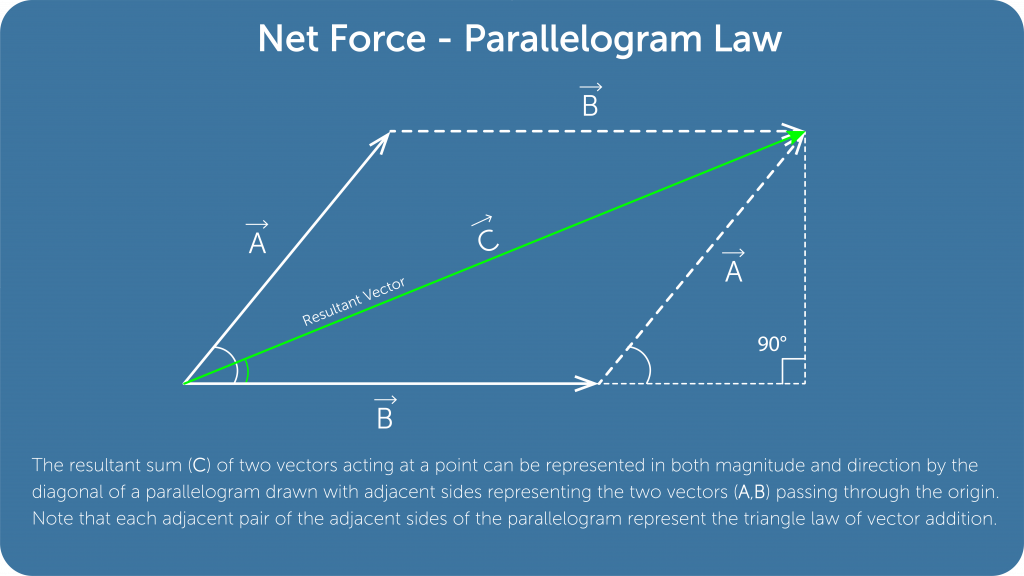
- Methods such as the parallelogram law of vector addition can be used to determine the resultant of two vectors.
| Scalar Quantities |
Vectors Quantities |
| Mass |
Weight |
| Length |
Force |
| Time |
Acceleration |
| Temperature |
Electric Field |
| Distance |
Magnetic Field |
| Speed |
Gravitational Field |
| Work |
Displacement |
| Pressure |
Moment |
| Energy |
Momentum |
| Potential Difference |
Impulse |
| Electric Charge |
Velocity |
| Current |
|
| Power |
|
| Resistance |
|
Parallelogram law of Vector addition