Characteristics of sound waves
- It travels in the form of a longitudinal wave consisting of alternate compressions and rarefactions.
- It cannot travel through vacuum- it needs a medium to travel.
- Speed of sound increases with the density of a medium.
- Speed of sound increases with increase in temperature.
- It can travel through solids, liquids, and gases.
- The approximate rage of audible frequencies for a healthy human ear is 20 Hz- 20000 Hz
- Infra-sound: frequency less than 20 Hz
- Ultra-sound: frequency more than 20000 Hz
- Loudness of a sound wave ∝ amplitude of sound waves
- Pitch of sound waves is the number of cycles of sound waves as heard by a person / second. It is measured in hertz (Hz)
- The frequency of sound waves is the number of cycles emitted by a source per unit time
- Pitch ∝ frequency
Compressions and Rarefactions
- Compressions are the points in a medium at which particles are crowded. Hence, pressure and density would be maximum.
- Rarefactions are the points where particles are widely separated. Hence pressure and density is the least.
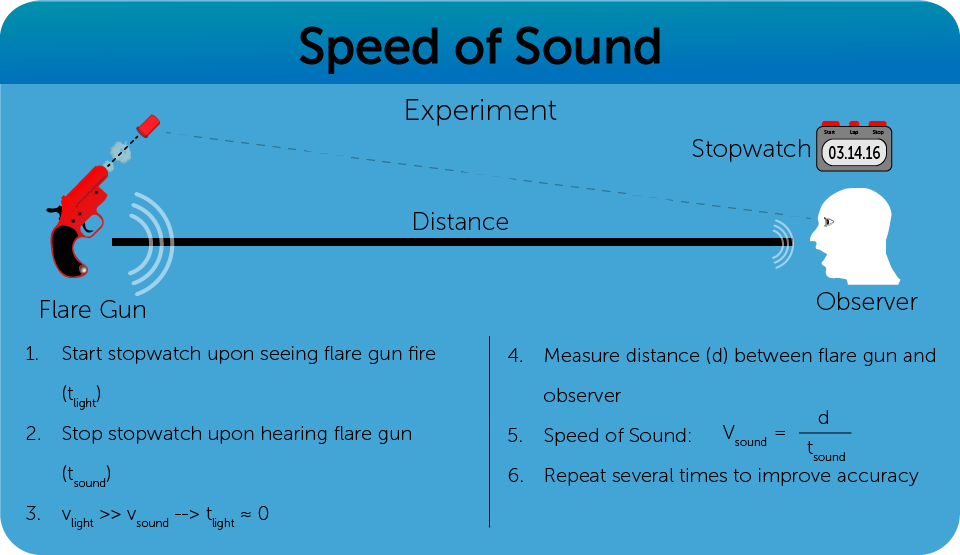
Speed of sound
| Medium |
Speed (m/s) |
| Vacuum |
0 |
| Air |
340 |
| Water |
1450 |
| Metal |
5000 |
3.4.2 Reflection of Sound: Echo
- Reflection of sound from an obstacle is called an echo.
- For a discernable echo, the time difference between two sound waves reaching the ear should be greater than 0.5 seconds
- The distance between the obstacle and the observer should be:

- where is the distance between the observer and the obstacle, is the to-and-fro time, and is the speed of sound in the air.

- This distance seems large, but if the sound can reflect multiple times before reaching our ear, then this echo can take place in smaller rooms.